Conflict of Light and Darkness — Complete Faction Battle Guide
Learn how to choose a faction, join faction battles, observe attack protections, gain and lose Elo, and advance through Light and Shadow ranks. Detailed calculation examples, the Castle of Balance and future city attacks.
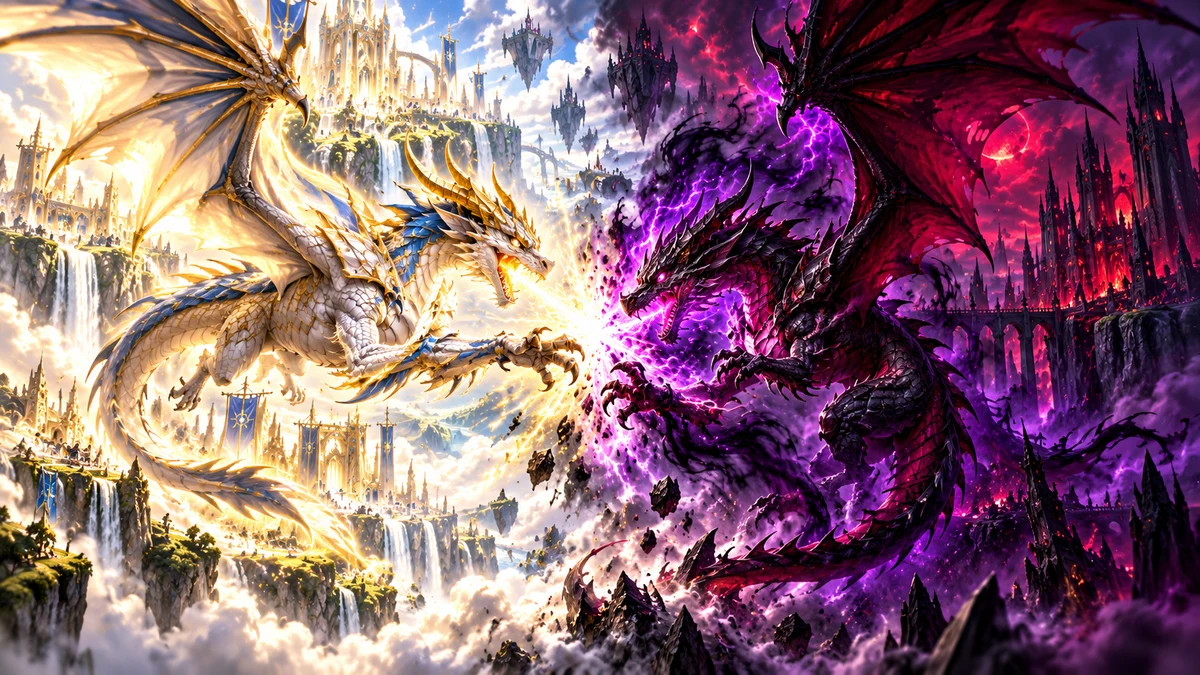
When Light and Darkness enter into conflict
In Dragons: Legends and Myths, every hero can remain neutral or bind their fate to the Light or the Shadows. The Conflict of Light and Darkness is a system of faction allegiance, ranks, its own Elo rating and battles between members of the two sides.
Light unites the defenders of Silvarin, Arcanor and KarnGor. The Shadows serve the Shadow Lord and are associated with Noctarium. Faction battles differ from ordinary PvP and battles for the Castle of Balance, although achievements in these systems influence the broader conflict.
Choosing a side and gaining allegiance
Allegiance means membership of one of the two factions. Initially, a hero is neutral. To join the Light, travel to one of the three cities of Light — Silvarin, Arcanor or KarnGor — and open the City Council. In Service to Light, select Swear an oath.
To join the Shadows, travel to Noctarium, open the City Council and select Kneel in Service to Shadows. The Shadows serve the Shadow Lord, but the title Shadow Lord itself is not available to players: it belongs to the faction's lord, not to one of its ranks.
On your first oath, you receive rank I and 0 Faction Elo. If the character previously left a faction, rejoining restores the Elo remaining after the penalty (once the ban expires) and the corresponding ordinary rank. Your allegiance is displayed in your profile and other game cards with the image of your current rank. You cannot belong to Light and Darkness simultaneously.
Finding your rating, rank and leading fighters
Open City Council → Service to Light / Service to Shadows. Here you can see your allegiance, current Faction Elo, rank image and name, progress toward the next threshold, the entire ten-rank ladder and the TOP-10 fighters of your side.
TOP-10 positions are sorted by Elo: the hero with the higher rating ranks first; ties are resolved by time of joining. This is the faction rating, not your overall PvP rating or character level.
Starting a faction battle
A direct battle begins when one player attacks another. Open the card of an eligible character and use Attack. If the attack is permitted, the battle begins immediately between the initial two opponents; a mass faction battle appears in the Arena, where other participants can join.
An attack by a Light player on a Shadow or vice versa creates a conflict between opposing sides. A Shadow may also attack a neutral player, but a Light player cannot initiate such an attack. A Shadow versus neutral fight grants no Faction Elo to either side, even if the Shadow wins. If a member of Light joins to defend the neutral player, both actual factions become represented and the battle becomes a rated faction battle. In any case, a neutral player receives no Faction Elo and does not gain allegiance.
In Silvarin, Arcanor and KarnGor, Light and Shadow players can initiate attacks against one another. In Noctarium, a Shadow may initiate an attack on a Light player, but a Light player cannot initiate an attack on a Shadow. This protects Shadows from attacks being initiated against them in Noctarium, not from damage in battle: if a Shadow initiated the attack, they participate under the ordinary combat conditions.
Mandatory attack conditions
Before an attack, the game checks several requirements simultaneously. If any fail, the opponent's card displays the reason.
• Both sides must be in the same city. You cannot attack a target in another city.
• The target must be online. An attack cannot be initiated against an absent player.
• Both attacker and target must have strictly more than 80% of maximum HP. Exactly 80% is insufficient.
• The opponent must not be at home or in the Temple. You also cannot initiate an attack if either participant is occupied with an active battle or another incompatible action: an Arena request, mass quest, castle assault, active event and so on.
• Effective-level restrictions apply. The attacker may be no more than 3 levels above the target and no more than 10 levels below them. For example, a level 30 hero can be attacked by characters of levels 20–33.
• The target must have a Power Index of at least 25. You cannot attack a character below that threshold.
• You cannot attack a member of your own faction.
Protection against repeated attacks
A Light or Shadow player who has been attacked receives protection for 3 hours. It belongs to the attacked character and applies against the entire opposing faction: changing the attacker to another ally does not bypass it. The countdown starts from the last recorded attack; the target becomes available again when protection expires.
Shadows may attack the same neutral player once per day. The restriction resets daily at 00:00 (UTC+3). Once that neutral player has been attacked, other Shadows cannot attack them until the reset. Other neutral players can still be attacked if the remaining conditions are met.
There is no overall daily limit on how many times different Light and Shadow players fight different opponents. Protection restricts repeated attacks on a particular target, not the total number of faction battles.
Mass battles and allied reinforcements
The initial battle between two players becomes open to reinforcements in the Arena's faction battles tab. A neutral hero can see these battles but must choose a side to join.
You may join only on your own faction's side, provided the battle has not ended, 30 minutes have not elapsed since its start, and a slot remains available. Characters from level 10 can join if their effective level differs by no more than 10 from the average effective level of the two initial fighters. For example, with starting levels 30 and 40, the average is 35; eligible participants are levels 25–45.
The standard format is 6×6. Through control of the Castle of Balance, the side that gained an advantage in the previous week may receive 7×6 or 8×6. A side has a maximum of eight players. Summoned creatures do not occupy faction player slots.
What is Faction Elo?
Faction Elo is a separate reputation score for members of a faction. It does not replace ordinary PvP or PvE rating. On first joining, you start at 0 Elo; after swearing an oath again, you recover the Elo remaining after your renunciation penalty. Subsequent changes depend on the outcome of the faction battle and your personal combat contribution. The designated victory reward for the Castle of Balance also affects faction rating.
The system's principle is that a useful participant receives a larger reward for victory and loses less on defeat. Thus, allies who win the same battle may receive different amounts of Elo, and a winning participant with negative contribution may even lose points.
Actions counted toward combat contribution
Combat contribution is calculated from actual actions in battle, not who stayed longest or announced themselves loudest. Registered useful actions include damage dealt, healing, defeating enemies and helping prepare their defeat, prevented damage, reflection, certain forms of control, effect removal and support, and actions of skills, elements, scrolls, pets and runes.
The calculation considers effectiveness and the state of the battle. An important action that helps reverse an unfavorable situation may be worth more than the same action in an already won fight. Someone who helped prepare an opponent's defeat may receive part of the credit for it.
Joining late is not itself penalized. If a player objectively had no opportunity to act, that is taken into account. When there was a real opportunity to help, a lack of contribution or unproductive occupation of a limited slot does not necessarily earn a reward. Initiating a faction battle grants a small initiative bonus, but it does not replace useful actions during battle.
The system evaluates actual usefulness to the team. Not every action necessarily increases personal contribution.
When Elo is gained or lost
Team victory. With nonnegative personal contribution, Elo increases. The higher your contribution share, the more significant your key actions and the stronger opponents are by Elo, the higher the possible reward. A numerical advantage on your own side reduces the reward.
Victory with negative contribution. Your allies' victory does not guarantee a reward: a participant with genuinely negative contribution may lose Elo. The assessment is based on actions, not simply death or weak equipment.
Team defeat. Elo decreases. A large share of useful contribution and significant actions reduce the loss, but under current rules they do not turn an ordinary defeat into a positive Elo gain.
Draw. If your total personal contribution is nonnegative, a small Elo gain is possible. Negative contribution results in Elo loss. The amount also depends on the contribution share.
Lower limit: Elo cannot fall below 0. You cannot lose more points than you have when the calculation is made.
In detail: what determines Elo changes
The calculation uses several factors simultaneously:
1. Personal contribution to the team result. Each player's positive contribution is compared with the team's total positive contribution. The larger your share, the higher the victory reward multiplier. It has a lower limit: a victory with zero but nonnegative contribution may still yield a small gain.
2. Significance of actions. The calculation considers how much useful actions changed the battle's situation. This is an additional victory reward multiplier and protection against loss on defeat.
3. Opposing side's Elo strength. Your current Elo is compared with the average Elo of opposing fighters. Victory against a higher-rated team is worth more; victory against a lower-rated team is worth less.
4. Team size ratio. Victory while outnumbered may yield a larger gain; numerical superiority reduces the reward. This multiplier applies to faction battle formats including 7×6 and 8×6.
5. Current Elo on defeat. At early stages, protection against large losses applies and gradually decreases as rating grows.
The change is calculated individually after the battle ends. The exact amount is not a fixed reward for victory determined in advance: it varies with contributions and team composition.
How Faction Elo points are calculated
Points are awarded after the battle ends, separately for each faction participant. Personal contribution and the team result are considered. No points are awarded merely for time spent in the battle. The base calculation value is 24 points; multipliers are then applied.
Victory with nonnegative combat contribution:
Elo change = round(24 × S × I × D × N).
S — personal contribution share: your useful contribution share is doubled and added to 0.5 (an addition of at most 1.5). A 0% share gives a multiplier of 0.5; 25% gives 1; 50% gives 1.5; 100% gives 2. This measures overall usefulness to the team, not merely damage dealt.
I — significance of actions: starts at 1 and increases for actions that meaningfully change the team's situation. The additional amount is at most 0.75; the maximum multiplier is 1.75.
D — Elo difficulty: D = 2 raised to the power of ((average opponent Elo − your Elo) / 400), limited to between 0.35 and 2. At equal rating D = 1. Victory over fighters with higher Elo awards more points.
N — team size: N = number of opponents / number of allies, with a minimum of 0.5 and a maximum of 1.75. In 6×6 it is 1; in 6×8 it is approximately 1.33 for the side with six fighters and 0.75 for eight fighters against six.
Defeat: personal contribution and significant actions protect some Elo from loss. Protection Q consists of 85% of your useful contribution share and an addition for action significance (no more than 0.25); overall protection is capped at 0.85. Loss before beginner protection: L = the greater of 3.6 and 24 × (1 − Q) / D / N. When dividing, D and N are each treated as at least 0.5. L is then multiplied by beginner factor P and rounded. If the hero has points, the loss is at least one Elo.
Beginner protection P depends on rating before the battle: below 1000 Elo, the loss multiplier is 0.25; from 1000 to 1399, 0.5; from 1400 to 1799, 0.75; from 1800 Elo, 1. Thus an experienced participant may lose more points than a beginner in an otherwise identical defeat.
Victory with negative contribution: a penalty replaces the reward, depending on how negative the contribution was and the same beginner protection P. A team victory does not cancel the consequences of your own unproductive or harmful actions.
Draw: a small change equal to rounded 3.6 × S. It is positive for nonnegative contribution and negative for negative contribution. Opponent difficulty and team size do not affect the amount here.
After any outcome, Elo cannot be less than zero. Useful contribution share is not equivalent to your percentage of damage dealt: healing, defense and other actions also affect the result.
Examples of gains and losses
Below are illustrative calculation examples assuming both sides have equal Elo, the battle is 1×1, there are no additional significance bonuses and the team size ratio is one. Specific amounts will differ in mass battles.
Victory, positive contribution: 100% share — about +48 Elo; 50% share — +36; 25% share — +24. With nonnegative assessment and a zero share the example gives +12. Significant actions or higher opponent Elo may increase the reward.
Ordinary defeat without useful contribution: with current Elo from 0 to 999 — −6; at 1000–1399 — −12; at 1400–1799 — −18; at 1800 and above — −24.
Defeat with especially high contribution (100% share): in the same four ranges, losses fall to approximately −1, −2, −3, −4 Elo, respectively.
Draw: a 100% useful contribution share gives +7 Elo; a 50% share gives +5 Elo. Negative personal contribution in a draw may result in a loss.
Victory with negative contribution: the penalty depends on how negative the action assessment is. Thus even a winning player does not automatically receive a positive result.
These are not fixed tariffs or guaranteed points: actual mass faction battles account for all fighters, their contributions and Elo.
Light and Shadow rank thresholds
Both factions use the same Elo scale, but their rank names and images differ. Rank changes with current rating: Elo increases and decreases can promote or demote a hero. Previous service is recorded in history. Both factions' emblems are shown for each rank below. Select an emblem to enlarge it.
Rank I — 0–999 Elo: Light — Oathsworn to the Light; Shadows — The Kneeling.
Rank II — 1000–1199 Elo: Light — Spark of Light; Shadows — Whisper of Darkness.
Rank III — 1200–1399 Elo: Light — Bearer of Light; Shadows — Bearer of Corruption.
Rank IV — 1400–1599 Elo: Light — Dawn Blade; Shadows — Blade of Night.
Rank V — 1600–1799 Elo: Light — Flamekeeper; Shadows — Devourer of Light.
Rank VI — 1800–1999 Elo: Light — Dawn Herald; Shadows — Herald of Darkness.
Rank VII — 2000–2199 Elo: Light — Radiant Guardian; Shadows — Shadow Punisher.
Rank VIII — 2200–2399 Elo: Light — Exalted; Shadows — Chosen of the Lord.
Rank IX — from 2400 Elo: Light — Hand of Light; Shadows — Hand of the Lord.
Rank X — the highest unique title: Light — First Lightbearer; Shadows — First Shadow. It may be held by only one player per faction: the highest-rated hero among those who have earned at least 2600 Elo. If Elo is tied, the player who joined the faction earlier takes precedence. If another fighter overtakes the leader, the current leader returns to rank IX and the new leader receives X. If the leader's Elo falls below 2600 or they leave the faction, the title passes to the next eligible member; if there is none, it remains vacant.
Renouncing allegiance and becoming neutral
If you already serve a faction, your City Council provides the Betray and leave action. The system warns you about the consequences before confirmation. After renouncing, your character no longer belongs to the Light or Shadows and becomes neutral. Previous service records remain in history.
When renouncing, 75% of current Elo is retained after the first betrayal of that faction, or 50% after a repeated betrayal of the same faction. The result is rounded down to a whole number. For example, leaving the Light for the first time at 2000 Elo leaves 1500 Elo, while a repeated betrayal of the Light at 2000 Elo leaves 1000 Elo. Betrayal counts for Light and Shadows are tracked separately; previous service history is preserved. After renunciation, the hero is neutral, and the remaining points are temporarily retained without an active faction rank.
Rejoining is blocked for 24 hours after the first betrayal of the relevant faction and for 7 days after a repeated betrayal. The Council displays the date the restriction ends with the UTC+3 time zone. Once the ban ends, you can swear an oath to Light or join the Shadows again: the new Faction Elo equals the amount retained after the penalty, and rank is determined by this value. During the waiting period the oath button is unavailable.
To adopt another allegiance, first renounce your current one, then visit the City Council of the new side. A direct one-click transfer through the Council is not currently supported.
Castle of Balance and faction battle advantages
The Castle of Balance is a separate, already active system within the Conflict of Light and Darkness. The factions fight for ownership and shift a shared control meter of 1000 points, divided between Light and Darkness. Ownership influences control accumulation.
A victory when capturing or successfully defending the castle grants each participating fighter of the winning faction +10 Faction Elo. The successful side also receives the silver specified by the castle rules. The losing side does not receive this reward.
On Monday at 00:00 (UTC+3) the game saves the previous week's control result. The live meter is not reset: the struggle for the same 1000 points continues. The difference in saved points determines the numerical advantage for the following week:
• Advantage up to and including 30% (point difference up to 300 out of 1000) — standard 6×6 format.
• Advantage greater than 30% but no greater than 70% — the leading side may field 7 fighters against 6.
• Advantage greater than 70% — the leading side may field 8 fighters against 6.
Example: a score of 650 to 350 means a 300-point difference, exactly 30%; 6×6 applies. A score of 800 to 200 means a 600-point difference, or 60%; the leading side receives 7×6.
Numerical advantage alone does not guarantee victory: everyone's contribution is still considered when calculating Elo.
Coming later: city attacks
Attacks by one city on another are in development. This is a future, separate type of conflict, distinct from both one character attacking another and assaults on the Castle of Balance.
In the future, city conflicts will involve treasuries and the ability of winners to claim part of the defeated city's resources. Rules for attacks, distribution of spoils and participation will be described separately once the system is implemented and verified. It should not be considered available yet.
Quick reference for fighters
Join a faction: City Council → swear an oath to Light or kneel before the Shadow Lord. First oath: 0 Elo and rank I; returning after betrayal: Elo retained after the penalty and the ban period.
Find a battle: eligible opponent's card → Attack; to support allies, Arena → faction battles.
Check attack eligibility: same city, target online, both above 80% HP, suitable levels, target Power Index at least 25, no incompatible activity or active protection on the target.
Remember the cooldown: for a particular Light or Shadow player — 3 hours; for a particular neutral target of the Shadows — until the next 00:00 (UTC+3).
Increase Elo: help your team in faction battles, win with good contribution and participate in victories for the Castle of Balance. Defeats reduce Elo, but useful actions can preserve much of your rating.
View ranks: City Council → rank ladder and TOP-10.
Leave a faction: City Council → Betray and leave → confirm. The penalty is 25% or 50% of Elo, followed by a ban of 24 hours or 7 days; the remaining points return with your next oath.
Light and Darkness contend for more than victory in a single battle. Every choice of side, every clash and every position held gradually changes the balance of the entire world.