Combat System — Complete Guide
A detailed guide to combat in Dragons: Legends and Myths. Battlefield controls, damage and defense calculations, skills, scrolls, runes, elements, mounts, action order and effective combat tactics.
The art of combat
In Dragons: Legends and Myths, victory depends on more than a character's strength and equipment quality. Every fight is a contest of tactics, calculation and the ability to use your capabilities.
Choosing the right attack direction, using a skill at the right moment, defending intelligently or landing a successful ricochet can change the outcome of even the most difficult duel.
The combat system combines physical attacks, magic, defense, elemental powers, runes, scrolls, special equipment abilities and assistance from mounts.
This guide explains how battles proceed, what influences their outcome and the order in which actions resolve.
1. Basic combat principles
Battles are turn-based. Each participant selects actions, after which their results are determined.
An ordinary attack requires two decisions:
• Choose your own movement or block direction.
• Choose the direction or zone to strike.
You can additionally use an available active skill and combat scrolls.
Your opponent also takes their own actions. In a battle against another player, both participants make choices for one combat exchange. The result therefore depends not only on your attack but also on your opponent's decision.
Important: hitting, damage amount and additional effects are distinct aspects of combat. A powerful attack deals no ordinary direct damage if it does not reach its target.
2. Getting to know the combat interface
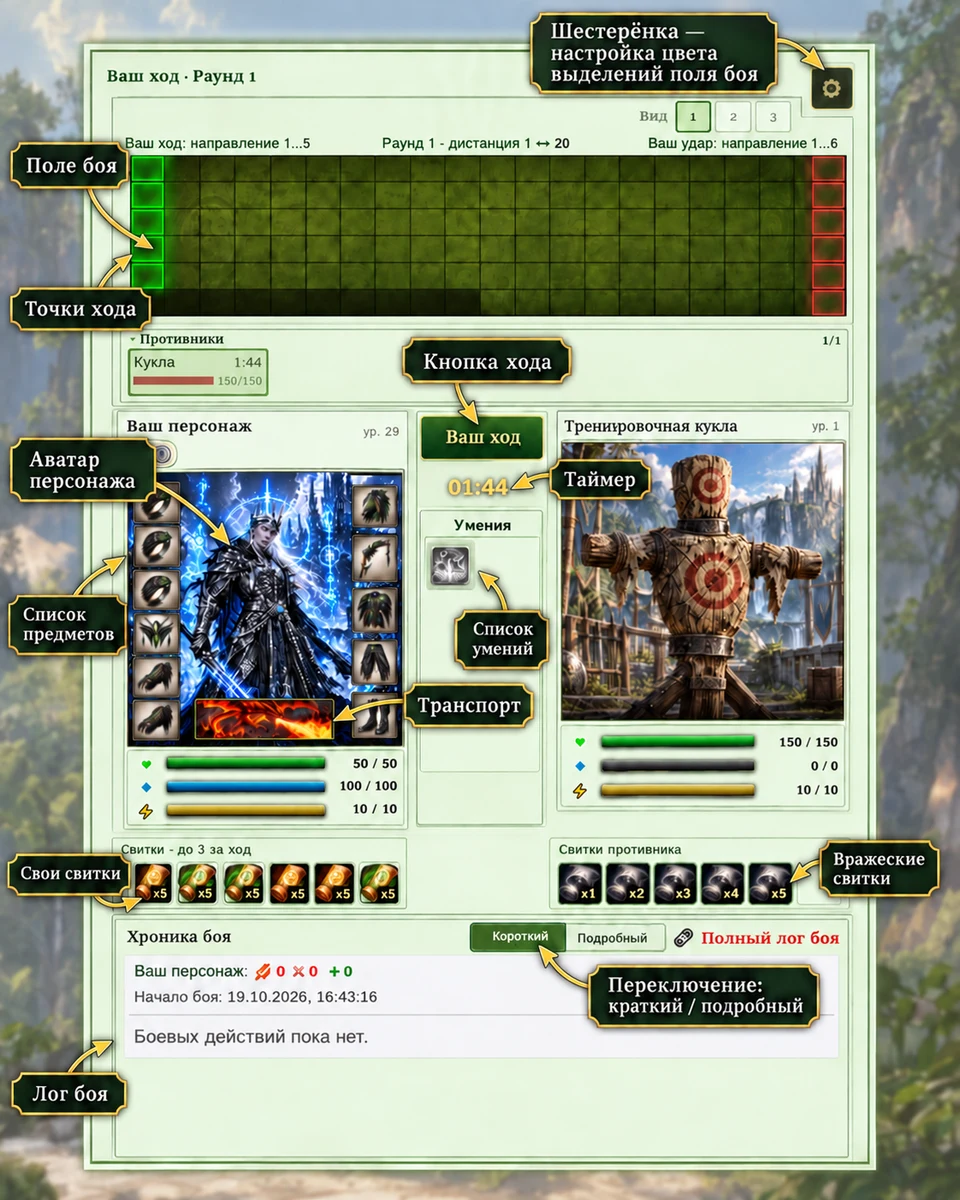
The combat screen is divided into several main areas.
Battlefield
Located at the top of the screen. Here you select movement, block and attack directions. The field displays markers for your actions and your opponent's actions in completed rounds.
Character card
Usually on the left. It contains the avatar, level and health, mana and energy indicators. Equipped item slots surround the character image.
Equipment determines many combat attributes and may grant additional abilities.
Opponent card
Usually on the right. It shows the current opponent, their level, image and available information about their condition.
Turn button
Confirms your chosen movement, attack and additional actions.
Timer
Shows the remaining time to make a decision.
Skills
The section for your character's available active abilities.
Scrolls
Separate panels for your combat scrolls and your opponent's scrolls.
Battle chronicle
A record of completed actions, damage dealt, skills used and other events.
All these areas are connected. Your selected skill or scroll supplements the main attack, and the result can be examined in the chronicle.
3. Combat screen layouts
The buttons “View 1”, “View 2” and “View 3” are located at the top of the interface.
They let you change the layout of the combat screen.
View 1 — compact
A familiar compact arrangement of the main elements. Suitable for quickly selecting actions and continuously observing the battlefield.
View 2 — chronicle-focused
A layout that gives more attention to the event log. Convenient for analyzing the consequences of attacks and abilities used.
View 3 — standard
An alternative combat panel arrangement suitable for a more expanded view.
Switching views does not change character stats, hit rules or damage calculations.
Choose whichever layout is most comfortable for you.
4. Battlefield color settings
A gear button is located in the upper-right corner.
It opens the combat highlight settings.
Available settings:
Ally color — the color marking your positions and actions.
Opponent color — the color marking your opponent's actions and positions.
Cell brightness — the intensity of battlefield cell highlights.
Marker brightness — the brightness of attack, block and other action markers on the field.
The Reset button restores the default appearance.
Colors may vary depending on the theme of the territory where the fight takes place.
All highlight settings are visual only. They do not affect attack power, hit probability or defense.
5. Two phases of combat
An ordinary confrontation passes through two successive stages:
• Ranged combat — rounds 1 through 10.
• Melee combat — starting in round 11.
At the beginning, opponents are at a distance from one another. As the battle progresses, the distance decreases.
Once opponents close in, the rules for choosing attacks and defense change.
6. Ranged combat: rounds 1–10
During ranged combat, the field is 20 cells wide.
The number of available movement directions depends on the character's mobility. A maximum of six directions is possible.
Each turn requires two selections.
The first is movement direction.
It determines the direction in which your character will be positioned when the current exchange resolves.
The second is attack direction.
It determines the opponent's direction at which your strike is aimed.
For example:
You choose movement direction 2 and attack direction 4.
If the opponent moves in direction 4, the main strike hits.
If the opponent chooses a different direction, the main strike is considered a miss.
The main rule of ranged combat: your attack direction must match your opponent's movement direction.
High attack power alone cannot correct a poorly chosen direction.
Watch your opponent's behavior, notice repeated choices and vary your own tactics.
7. Transition to melee combat
Starting in round 11, opponents enter melee combat.
The field remains 20 cells wide, but four combat zones are now used.
Instead of movement, the character chooses a block, and instead of a shot direction, chooses the zone to strike.
Combat zones:
1 — Head.
2 — Chest.
3 — Waist.
4 — Legs.
An attack is now determined not by guessing a movement direction, but by attempting to overcome the protection of a particular body part.
8. How blocks work
Each block position protects two zones.
Block 1: head and legs.
Block 2: head and chest.
Block 3: chest and waist.
Block 4: waist and legs.
For example, you choose block 2.
The head and chest are protected. An opponent's strikes to the waist and legs will not be stopped by this block.
If an opponent attacks a protected zone, the attack is blocked.
If they attack an unprotected zone, the strike reaches its target and proceeds to damage calculation.
Anticipating your opponent's moves is especially important here.
A blocked ordinary strike deals 0 damage. It does not trigger an ordinary ricochet or additional effects associated with direct hits.
9. Keyboard controls
Number-key controls are available for convenient, fast-paced battles.
In ranged combat, use digits from 1 to 6, within the character's available directions.
In melee combat, use digits from 1 to 4.
How to take a turn:
1. Press a digit to select movement or a block.
2. Press a digit to select the attack direction.
3. Press Enter to confirm.
Once both values are selected, pressing number keys again lets you change the selection.
Esc cancels the currently selected directions and active skill.
Enter confirms the prepared action.
If both required directions have not been selected, Enter performs the interface's designated skip action, rather than a partial attack.
You can also select directions with the mouse by clicking battlefield cells.
Clicking an already selected cell again cancels that selection.
On mobile devices, controls are operated by tapping available buttons and cells.
Keyboard commands are not intercepted when you are typing in an input field.
10. Time to make a decision
Every combat action has a time limit.
Standard values:
• Ordinary battle — 120 seconds.
• Mass battle — 300 seconds.
Special battles may have their own rules.
The timer shows the time remaining for the current action.
If your opponent has already confirmed their choice, your delay does not cancel their action.
When the time expires, a character may die for missing the combat deadline.
Do not leave an active battle unattended.
In mass battles, time may be counted separately for different opponents.
11. Main combat attributes
Several groups of attributes participate in battle calculations.
Health (HP)
The character's life force. When health reaches zero, the character dies.
Mana (MP)
Used for magical skills and combat scrolls.
Energy
Spent on certain active abilities.
Ranged strength
Determines the base physical power of an attack at a distance.
Melee strength
Determines the base physical power of a strike after closing in.
Magic
Influences the range of base physical attacks, scroll usage and available stages of certain skills.
Direct-hit defense
Reduces ordinary physical damage in ranged combat.
Body-part defense
Used in melee combat. Protection for the head, chest, waist and legs is calculated separately.
Ricochet defense
Reduces damage from additional ricochet hits.
Additional attack power
May come from gear, runes, equipment sets and temporary buffs.
Base physical strength and additional bonuses do not participate in calculations in the same way.
12. How base strike strength is determined
The base strength of a physical strike is not always a single constant value.
The calculation uses a value from the range between base combat magic and the relevant base physical strength.
Let:
M be base combat magic.
S be base ranged or melee strength.
In an ordinary calculation, a random value from M to S is selected.
If M exceeds S, the upper limit nevertheless remains S.
For example:
Magic — 10.
Ranged strength — 30.
The base strength of a particular strike can range from 10 to 30 points.
Applicable bonuses from equipment and other active enhancements are then added to the result.
Higher magic increases the lower limit of base strike strength, but does not itself increase the upper limit beyond base physical strength.
This helps make attacks more consistent without eliminating the role of physical strength itself.
13. How distance affects damage
During ranged combat, the base portion of a physical attack gradually grows stronger as opponents close in.
The following values are used for the first ten rounds.
| Round | Base strength fraction |
|---|---|
| 1 | 55% |
| 2 | 60% |
| 3 | 65% |
| 4 | 70% |
| 5 | 75% |
| 6 | 80% |
| 7 | 85% |
| 8 | 90% |
| 9 | 95% |
| 10 | 100% |
An ordinary ranged strike is therefore weaker at the start of battle, approaching full strength with each subsequent round.
Ranged strike formula:
Attack = base strength × current round coefficient + additional bonuses.
Damage = the maximum of 0 and the following result: attack rounded up − direct-hit defense.
Example:
Base strength — 20.
First round — 55%.
Additional equipment strength — 5.
Opponent's defense — 4.
Calculation:
20 × 0.55 = 11.
11 + 5 = 16 attack.
16 − 4 = 12 damage.
In the tenth round, with the same values:
20 × 1.00 + 5 − 4 = 21 damage.
This example excludes additional elemental and special effects.
Note that additional equipment strength is not reduced along with base strength because of distance.
Some special abilities allow attacks without the normal distance-related strength reduction. When such an effect is active, the corresponding restriction does not apply.
14. Calculating melee strikes
After the transition to melee, range coefficients are no longer used.
Melee strike formula:
Attack = base melee strength + additional bonuses.
Damage = the maximum of 0 and the following result: attack rounded up − defense of the attacked zone.
Example:
Base strength — 30.
Additional strength — 8.
Opponent's chest defense — 12.
Result:
30 + 8 − 12 = 26 damage.
However, if the opponent selects a block protecting their chest, the ordinary strike is fully blocked.
Head defense may differ significantly from leg or waist defense.
Thus, even with identical attack power, damage to different zones may vary.
15. Additional enhancements and defense
These formulas describe the basis of the calculation.
The final result can be influenced by:
• Equipment enhancements.
• Item set bonuses.
• Temporary stat increases or decreases.
• Combat skills.
• Elemental effects.
• Special defensive abilities.
• Attack evasion.
• Critical hits.
• Other active combat effects.
Some abilities strengthen the calculated strike, others alter defense, and others act after physical damage has been determined.
Therefore, seemingly identical attacks may produce different results.
It is not only the amount of strength that matters, but also the stage of combat at which a particular ability triggers.
16. Ricochet — an additional hit
Ricochet is a special component of physical attacks.
It is calculated separately from an ordinary strike and uses its own defense stat.
In ranged combat, a ricochet can reach an opponent even when the main strike misses.
In melee combat, a ricochet is possible only after a successful main hit.
Ricochet direction is determined separately.
In ranged combat, it must match the opponent's position.
In melee combat, a ricochet does not damage a zone protected by the selected block.
Simplified ricochet formula:
Ricochet attack = random base ricochet strength + additional ricochet bonuses.
Ricochet damage = the maximum of 0 and the following result: ricochet attack − ricochet defense.
Base ricochet strength is tied to the character's magic. Its upper limit is half of base combat magic, rounded up.
If magic is absent, the base magical portion of ricochet is zero, but additional bonuses may still contribute to the calculation.
The normal ranged damage reduction by round does not apply to ricochet.
Important: ricochet is not a second ordinary direct strike.
Abilities that require a direct hit do not trigger solely because of a successful ricochet unless their description specifically provides for that condition.
17. Hits, misses, blocks and evasion
Several possible outcomes must be distinguished in combat.
Hit
The attack reaches the chosen target. Damage calculation and applicable additional effects then take place.
Miss
In ranged combat, the attack direction does not match the opponent's movement direction.
The main physical strike does not reach the target.
Block
In melee combat, the strike lands in a protected zone.
Ordinary physical damage is fully prevented.
Evasion
Certain defensive abilities allow a character to avoid a strike that has already been aimed at them.
This differs from an ordinary miss caused by an incorrectly chosen direction.
Zero damage
Another outcome is possible: the strike reaches its target, but defense fully absorbs the calculated physical attack.
This does not necessarily mean a miss either.
These distinctions are important for skills, runes and hit reactions.
18. Active combat skills
Active skills are displayed in a separate panel.
To use a skill, select its icon before confirming your turn.
Within one ordinary action, you can combine:
• The main physical strike.
• One selected active skill.
• Permitted combat scrolls.
Skill availability depends on its own conditions.
These may include:
• Sufficient mana.
• Sufficient energy.
• No active cooldown.
• Appropriate skill stage.
• The required character state.
• No temporary prohibition on using abilities.
Unavailable skills appear dimmed.
Hovering over them or opening a tooltip explains the restriction.
Selecting the chosen skill again deselects it.
19. Skill stages
Some skills have several stages of strength.
A stage may influence:
• Ability power.
• Mana cost.
• Energy cost.
• Effect duration.
• Strength of a buff or debuff.
• Ability cooldown.
• Additional properties.
The available stage is determined by current combat attributes and the skill's own conditions.
Consequently, a skill with the same name does not necessarily work identically for two characters.
20. Types of combat skills
Skills can be divided into several main groups according to their purpose.
Offensive
Strengthen physical strikes, deal additional damage or strike multiple targets.
Defensive
Allow you to evade a strike, reduce incoming damage or gain temporary protection.
Restorative
Replenish health or other combat resources.
Enhancing
Temporarily increase character attributes.
Weakening
Reduce opponent attributes or apply negative effects.
Reactive
Trigger in response to a hit, damage received or another specific combat event.
Summoning
Allow you to summon an allied creature or use a special creature-related ability.
The precise capabilities of each skill are determined by its description.
21. When skills trigger
One of the most important combat principles is that different skills resolve at different moments.
On use
The effect applies after your action is accepted and does not necessarily depend on a physical attack hitting.
For example, a defensive enhancement or restoration may occur before the result of an ordinary strike is determined.
On direct hit
The skill acts after a physical strike actually reaches its target and passes the necessary checks.
A miss or block does not satisfy this trigger condition.
On ricochet hit
The ability reacts specifically to a successful ricochet hit.
It may trigger even when the main ranged attack misses, provided the ricochet independently reaches the target.
On taking damage
Defensive and retaliatory abilities may respond to an incoming strike.
While a temporary effect is active
Some abilities continue for several turns, periodically restoring health, dealing damage or changing stats.
Important: “on use” and “on hit” describe different conditions.
If a skill requires a hit, selecting its icon alone is not sufficient to deal the corresponding damage to the enemy.
22. Passive skills
Passive abilities do not require a separate selection every turn.
They act automatically when their conditions are met.
Depending on the skill, the effect may:
• Be active from the beginning of battle.
• Trigger on an ordinary hit.
• React to a successful ricochet.
• Help when receiving a strike.
• Temporarily modify attributes.
• Apply additional effects.
Passive skills do not occupy the selected active skill slot.
They may interact with the main strike and other active abilities.
However, without the appropriate event the corresponding passive effect may not trigger.
23. Skill cooldowns
Some active skills cannot be used every round.
After use, a cooldown period begins.
The remaining number of rounds is displayed next to the skill icon.
Until recovery is complete, the skill cannot be used again.
Different skills may track cooldowns for the character as a whole or separately for each specific target.
This is particularly important in battles with multiple opponents.
24. Temporary enhancements and negative effects
Combat can involve effects that persist over several turns.
These include:
• Increased attack power.
• Enhanced defense.
• Opponent weakening.
• Damage over time.
• Health restoration over time.
• Blindness.
• Defensive reactions.
• Damage reflection.
• Changes to other attributes.
The duration of such effects is usually linked to the combat turns of the character on whom they are applied.
For example, a three-turn negative effect lasts for the designated three turns of the affected target.
Some effects trigger precisely when the next combat turn begins, before the main physical strike.
This means a character may take damage from an existing negative effect before completing their next attack.
If their health is depleted first, their subsequent actions do not take place.
25. Blindness and removing blindness
Blindness is a special negative effect.
While it is active, the ordinary physical component of a hit can be reduced to zero.
Nevertheless, a correctly chosen direction can still count as reaching the target.
This is an important distinction from an ordinary miss.
Using an appropriate blindness removal effect removes the existing condition.
Removing blindness does not provide permanent protection from its reapplication.
Some special abilities may have their own rules for interacting with blindness.
26. Combat scrolls
Scrolls let you supplement ordinary attacks with magical actions.
The combat screen provides six slots for your own scrolls.
Each slot can hold up to five scrolls of one type.
A complete loadout can therefore contain up to 30 scrolls.
No more than three scrolls can be selected for a single ordinary combat turn.
They can be used together with the chosen active skill.
Scrolls can:
• Restore health.
• Deal magical damage.
• Apply negative effects.
• Remove certain effects.
• Summon creatures.
• Perform other actions designated for the particular scroll.
Not every scroll necessarily targets a single opponent.
Some affect the character, allies, opponents or several combat participants at once.
27. Selecting scrolls
Select a scroll by clicking its icon.
Left mouse button — add one use of the selected scroll.
Right mouse button — remove one selected use.
On mobile devices, a separate button reduces the quantity.
The number on the icon shows the available supply of scrolls in that slot.
A separate indicator shows how many scrolls are selected for the current turn.
The following restrictions apply when preparing an action:
• No more than three scrolls.
• No more than the actual available quantity.
• The scrolls' combined magic requirement must not exceed available combat magic.
• Mana must be sufficient for all selected scrolls and the active skill together.
If an action does not meet these conditions, the corresponding combination is unavailable.
28. Scroll success probability
Magical scrolls may have their own success probability.
The standard calculation depends on the difference between the character's combat magic and the scroll's required magic.
Formula:
Chance = 50% + 10% × (character magic − scroll magic).
The result is limited to the range from 0% to 100%.
Example:
Character magic — 15.
Scroll magic — 12.
Difference — 3.
50% + 10% × 3 = 80%.
Thus the chance of successful use is 80%.
Individual scrolls may have special rules, including guaranteed effects.
Each selected scroll is checked separately.
Important: a scroll is consumed when used, even if its magical effect does not trigger.
The associated mana costs still apply.
29. When scrolls take effect
Not all scroll effects resolve at the same time.
Immediate scrolls
Apply after the turn is confirmed and the relevant checks are completed.
For example, health restoration or removing a condition may occur before the main strike.
Deferred scrolls
Perform their action after opposing combat actions have resolved.
This allows abilities whose result must depend on an exchange that has already taken place.
The sequence is determined by the properties of the individual scroll.
Using a scroll remains part of a single selected turn.
30. Opponent scrolls
The combat interface displays a separate panel for your opponent's scrolls.
It lets you see the presence of scrolls and their remaining quantity.
The contents of another player's slots are not revealed in advance.
You cannot learn all magical actions prepared by your opponent merely from the presence of scrolls.
This preserves tactical uncertainty.
After a scroll is used, the corresponding event may appear in the battle chronicle.
31. Runes and additional equipment effects
Runes may provide additional combat capabilities.
Depending on the type, they can:
• Modify attack attributes.
• Strengthen defense.
• Apply positive or negative effects.
• Restore health.
• React to direct hits.
• Trigger on ricochet hits.
• Restrict certain combat actions.
Not all runes behave identically.
Each may have its own activation conditions, duration and strength.
For example, certain Black Rune effects are tied specifically to successful ricochet hits.
The Red Rune can temporarily restrict the use of scrolls and active skills.
When such a restriction is active, the corresponding combat icons become unavailable.
Do not assume every rune triggers after every strike.
The result is determined by its own conditions and the events that occurred.
32. Elemental powers
Combat uses four main elements:
• Fire.
• Water.
• Air.
• Earth.
Each element has its own nature and effects.
Fire
Associated with strengthening offensive impact and the possibility of increasing damage.
Water
Has defensive properties that allow it to respond to an incoming strike with reflected impact.
Air
Associated with evasion and the ability to avoid a direct strike.
Earth
Can overcome part of an opponent's ordinary defense.
Elements can oppose one another. High elemental strength therefore does not guarantee an advantage over every opponent.
Elemental trigger probability has an upper limit of 80%.
This is the maximum permitted boundary, not a promise that it will trigger eight times out of ten.
Actual probabilities depend on the conditions of the confrontation and are not disclosed.
Elemental abilities can also interact with special skills and other active effects.
33. Critical hits and evasion
Certain passive or temporary abilities can further strengthen a successful hit.
A critical hit increases already calculated direct damage according to the active ability's properties.
However, the attack must first pass hit and evasion checks.
Certain defensive skills can prevent direct damage even after the attacker correctly chooses the attack direction.
Critical enhancement of an ordinary strike and ricochet are different mechanics.
Do not expect every main-strike enhancement to automatically increase ricochet damage.
34. Mounts in combat
Mounts affect more than character appearance.
In ranged combat, mounts can change the number of available movement directions.
Ordinary values:
• Character without a mount — 3 directions.
• Horse — 4 directions.
• Dragon — 5 directions.
• Pegasus — 6 directions.
The overall limit is six directions.
The more directions you have, the greater your choice of evasive movement and the harder it is for your opponent to predict your decision.
For example, a character with three directions can move only within those three available options.
A rider on a pegasus has all six available.
A mount does not automatically increase the physical strength of a strike.
Starting in round 11, the movement-direction advantage of mounts no longer applies, because melee combat uses the shared four zones.
35. Pegasi
Pegasi provide the maximum ordinary mobility in ranged combat.
Depending on the type, they may grant additional defensive benefits.
Black Pegasus — associated with additional protection from direct strikes.
White Pegasus — associated with additional protection from ricochet.
These defensive advantages are taken into account separately from ordinary attack calculation.
A pegasus does not perform independent dragon-type attacks.
36. Dragons in battle
A dragon can combine the properties of a mount and a combat companion.
While riding a dragon, a character has an increased number of movement directions in ranged combat.
A dragon can also use additional abilities.
These are linked to its owner's actions and do not require separate manual control of every strike.
After the owner's ordinary attack, the dragon may perform an additional action if the conditions of its ability are met.
Possible dragon actions:
• Tail strike.
• Claw strike.
• Elemental impact.
• Striking multiple targets.
• Applying negative effects.
• Defensive reaction.
Different dragons have distinct features.
Fire dragons are associated with fire damage, electric dragons with chain discharges, and other varieties have their own offensive or defensive properties.
37. Dragons' defensive abilities
Some dragon abilities are intended to protect the owner rather than attack.
Protection from a fatal blow is especially important.
When the required conditions are met, a dragon can take the danger upon itself and prevent its owner's death from that strike.
After such a rescue, the dragon stops participating in the current battle.
This is not guaranteed protection from every fatal effect.
It depends on the conditions of the particular ability.
38. Summoning a dragon during battle
Certain abilities allow you to summon a dragon directly during combat.
The specified conditions must be met.
These include:
• An available skill.
• Sufficient required resources.
• A suitable dragon state.
• Available mounting uses.
• Not already riding another dragon or pegasus.
After successful summoning, your character's current mount state changes.
In ranged combat this can increase the number of available movement directions during the battle itself.
You cannot ride several mounts at once.
39. Summoning combat allies
Certain skills and scrolls let you summon creatures directly into battle.
A summoned creature joins the summoner's side and becomes an independent combat participant.
It can:
• Choose an opponent.
• Attack.
• Use its designated abilities.
• Take damage.
• Die in battle.
A summoned creature does not replace the summoner's own actions.
Its participation supplements the team's capabilities.
This differs from a mounted dragon, whose additional actions are linked to its owner.
40. Mass battles
The combat system supports encounters involving multiple participants.
In mass battles, a character may have several allies and opponents.
Participant lists are used for control.
You can select an available living opponent against whom you intend to perform your next action.
Changing targets does not restart the battle.
Each individual confrontation may retain its own rounds and time limits.
Do not assume all mass battle participants are always in the same round.
Important features of mass battles:
• Allies and opponents are displayed separately.
• Defeated participants cannot continue ordinary actions.
• You can switch between available living targets.
• Mass skills can affect several participants.
• Summoned creatures can reinforce a side.
• The duration and state of individual confrontations may differ.
Choosing the right target is often just as important as the power of an individual attack.
41. Battle chronicle
The chronicle is at the bottom of the combat interface.
It lets you examine the results of completed actions.
The log may display:
• Battle round.
• Participants involved in actions.
• Selected directions.
• Hits and misses.
• Blocked strikes.
• Main physical damage.
• Ricochets.
• Skills used.
• Runes that triggered.
• Elemental effects.
• Dragon actions.
• Scroll usage.
• Health restoration.
• Application and expiration of temporary effects.
• Participant deaths.
The chronicle is especially useful for understanding why one strike dealt more damage than another.
42. Short and detailed chronicle
Switches above the log let you choose:
Short
Displays the main events in a more compact form.
Suitable for quickly following the course of a battle.
Detailed
Displays more information about completed actions and triggered effects.
Recommended when studying unfamiliar abilities or investigating an unexpected result.
You can also open the full battle log.
The full log can be opened separately to examine completed actions in detail.
If an attack or skill appears to work unusually, the detailed chronicle will help you understand what happened.
43. General sequence of a combat turn
The following describes the main sequence of an ordinary combat exchange.
Certain special skills may end a battle early, so not every battle necessarily proceeds through every listed stage.
Stage 1. Selecting an action
The player chooses their own movement direction or block, attack direction, available skill and necessary scrolls.
Stage 2. Confirmation
After the turn button is pressed, the game accepts the prepared actions.
The availability of chosen abilities and resources is checked.
Stage 3. Accounting for costs
For accepted magical actions, mana and energy costs, selected scrolls and restrictions on repeated skill use are taken into account.
Stage 4. Active effects
Relevant effects associated with the current combat turn are processed.
For example, a character may take another portion of damage from an existing negative effect or recover some health.
If the character dies at this stage, their subsequent attack does not take place.
Stage 5. Immediate abilities
Applicable abilities that act on use are applied.
These may include restoration, enhancement, removal of a negative effect or another effect.
If such an action ends the battle, the usual exchange of physical strikes may no longer be necessary.
Stage 6. Opponent actions
The opponent's choice is taken into account for the normal exchange.
In a battle between players, actions from both sides are required. Game-controlled opponents make decisions independently.
Stage 7. Determining a hit
Selected directions or zones are compared.
For ranged combat, the game determines whether the attack matches the target's movement.
For melee, it checks whether the attacked zone is protected by a block.
Stage 8. Calculating the main attack
If the strike reaches the target, its physical power is determined.
The combat type, primary attributes, additional bonuses and active enhancements are taken into account.
Stage 9. Defensive effects
Applicable defensive mechanics are applied.
These may include evasion, special defensive abilities and other reactions to a direct hit.
Stage 10. Final damage
The final amount of main physical damage is determined.
Applicable defense, possible critical enhancements, elemental effects and special damage modifications are taken into account.
Successfully dealt damage reduces the target's health.
Stage 11. Ricochet
A possible ricochet is determined separately.
Its direction or zone is checked, followed by the corresponding defense and final damage.
A ricochet may deal additional damage independently of an ordinary ranged hit.
Stage 12. Additional reactions
Following the main physical events, applicable reactions are processed:
• Runes linked to hits.
• Elemental reactions.
• Passive abilities.
• Direct-hit effects.
• Ricochet-hit effects.
• Retaliatory and defensive abilities.
Each acts only when its own conditions are met.
Stage 13. Additional dragon actions
If a character uses a dragon and the conditions are met, additional attacks or other dragon abilities may occur.
Stage 14. Deferred magical actions
After the main exchange, scrolls and effects designated to act after the opponent's response are applied.
Stage 15. End of round
Participant states are updated.
The game checks who remains alive, which effects are still active, which abilities are available and whether battle can continue.
Stage 16. Next turn or end of battle
If the confrontation continues, the next round opens.
If the end conditions are met, the outcome is determined and final events are recorded in the chronicle.
This is a general sequence for understanding combat. Individual abilities may have their own timing within the relevant stage.
44. Why effects do not all trigger at once
Suppose a character selects a physical strike, a restorative skill and a scroll.
After confirmation, designated immediate actions may occur first.
The game then determines whether the physical strike reached the opponent.
If the strike missed, restoration that does not depend on a hit may still take effect, but an additional effect requiring a direct hit will not be inflicted.
A ricochet may separately reach the target and trigger its own reactions.
Another example:
An opponent attacks, but your defensive ability lets you evade.
In that case, the calculation of the aimed strike and the actual loss of health will differ.
Finally, a temporary negative effect may deal damage before the next main attack.
The main rule: each skill acts at its own time and only when its own conditions are met.
45. What happens when a participant dies
When a character's health reaches zero, they are considered dead.
A defeated participant cannot continue ordinary combat actions.
If their attack has not yet resolved, subsequent actions may be canceled.
In mass battles, one participant's death does not necessarily end the entire battle.
If living allies remain on their side, the confrontation may continue.
Whether it can continue is determined by the state of all participating sides.
46. Ending a battle
A battle ends when the conditions for victory, defeat or another designated conclusion are met.
Afterward, the results and the history of completed actions are saved.
Depending on battle type, the game may record:
• Victory or defeat.
• Damage dealt and received.
• Healing and other useful actions.
• Participation in eliminating enemies.
• Consumable items used.
• Rewards received.
Reward conditions may differ according to battle type.
After an ordinary battle, character health does not necessarily recover immediately.
Mana is restored for the next separate battle, while remaining health can matter during successive battles.
Some special modes impose additional recovery restrictions between battles.
47. Important tactical tips
Do not choose directions randomly.
Observe your opponent's actions, especially if they tend to repeat the same choices.
Consider the current stage of battle.
Ranged physical damage is reduced at the beginning. Its base component increases as opponents close in.
Do not confuse misses and blocks.
In ranged combat, predict your opponent's direction. In melee, find an unprotected zone.
Remember ricochet.
It is calculated separately and can sometimes change the outcome of an unsuccessful ordinary attack.
Watch your resources.
Do not spend all your scrolls and mana in the first rounds if the battle may last longer.
Choose your moment for skills.
Abilities that strengthen a strike are particularly useful when the chance of a successful hit is sufficiently high.
Watch temporary effects.
Blindness, reduced defense or damage over time may matter more than one powerful strike.
Consider mounts.
Additional movement directions provide greater freedom in ranged combat.
Do not neglect defense.
A strong offensive character may lose to an opponent who chooses blocks better, uses defensive abilities and manages resources wisely.
Study the detailed chronicle.
It helps you understand not only how much damage you received, but also the sequence of events that led to it.
48. What to remember
The combat system is built on a combination of several decisions:
Choose the right movement.
Anticipate the opponent's action.
Find an unprotected zone.
Use your character's strength with distance in mind.
Enhance attacks with the appropriate skill.
Manage scrolls and resources wisely.
Consider the effects of runes, elements and mounts.
Understand which abilities trigger before the strike, on a hit and afterward.
Each of these components can influence the outcome.
A strong character has an advantage. But an experienced fighter knows how to turn even a small advantage into victory.
In the world of Dragons, victory belongs not only to those who strike hardest, but also to those who know when and where to strike.